

The Learning and Development Management System (LEMS) of the Land Salzburg (State of Salzburg) provides the Salzburger Verwaltungsakademie (Salzburg Administrative Academy) with a central platform for education and training. Based on open-source technologies such as Moodle and Drupal, it enables efficient workflows, approval processes, and automation, significantly reducing administrative effort for 3,000 employees, 9,000 participants, and 750 events. The project was implemented end-to-end by think modular.
Collaboration with the Land Salzburg (State of Salzburg) and the Salzburger Verwaltungsakademie (Salzburg Administrative Academy)
Project timeline Project start 2023 – ongoing
Project website https://www.svak.at/
Our scope of services
The Goal: A Central Learning Platform for 12,000 Users – Flexible, Scalable and Future-Proof.
The goal of the project was to develop a central digital learning and development platform for around 12,000 employees of the state and municipalities. It was designed to efficiently support the academy’s organizational processes while also meeting modern didactic requirements.
The focus was on the end-to-end digitalization and automation of academy processes in order to reduce administrative effort and ensure scalability. At the same time, existing HR development systems needed to be seamlessly integrated and made flexibly extensible via open interfaces.
Another key objective was the use of open-source technologies to ensure long-term independence, transparency, and economic sustainability. Equally important was an intuitive user experience that provides easy access for all target groups and avoids media disruptions.The platform was also designed to be flexible and adaptable to future requirements and new didactic concepts.
How this works in practice?
How this works in practice and how satisfied the Salzburger Verwaltungsakademie is with the solution is shown in the following video on the platform of Land Salzburg.
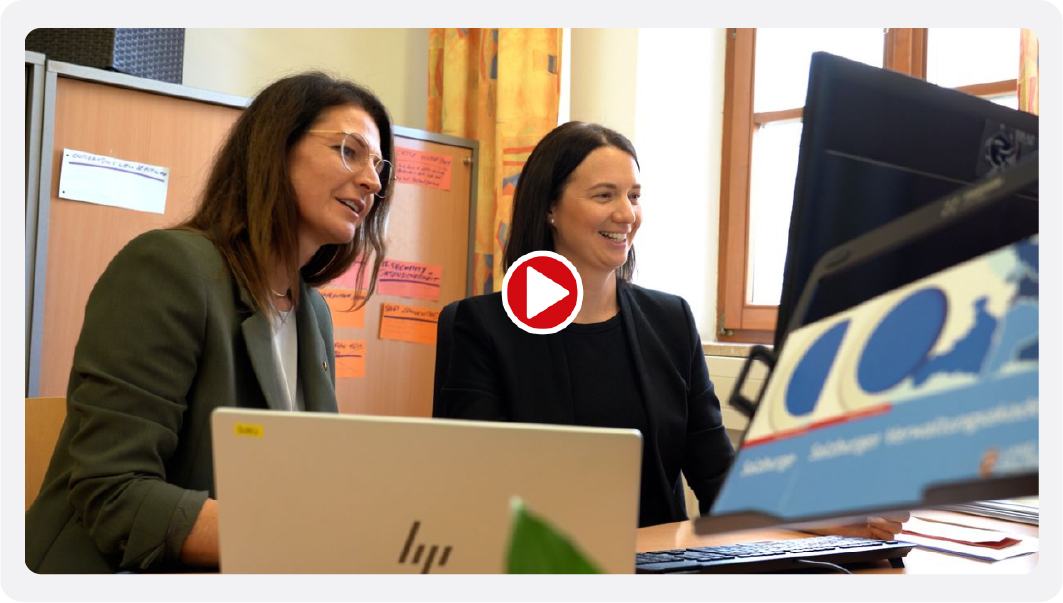
Watch the Video on Land Salzburg platform
The Initial Situation: Existing Training Programs, Events, and E-Learning Content - But No Central Structure.
Even before the introduction of the new platform, there was already a wide range of training programs, events, and e-learning content. However, these were distributed across a fragmented and heterogeneous system landscape and were only loosely connected.
The organization of events – from announcements and room bookings to registration, deregistration, evaluation, and billing – was handled through different systems and communication channels. This resulted in media disruptions, duplicated efforts, and a high level of manual work, along with an increased risk of errors.
Learning content was also provided in a decentralized manner through various channels such as the intranet, email, or websites. As a result, access for users was more difficult, and opportunities for interaction between participants, instructors, and the academy were significantly limited.
The Solution: A Certral Hub for Training and Employee Development.
As part of the conceptual design, over 100 use cases were defined to holistically map all core and supporting processes of the academy – from user management and course organization to learning content, reporting, and billing.
It quickly became clear that a traditional learning management system alone would not be able to meet these requirements. The solution was therefore a modular system architecture based on open-source technologies, combining the strengths of different systems:
- Central management and workflow system, including employee development
- E-learning platform for course delivery
- Integrated webinar and video conferencing platform
- Reporting and learning analytics
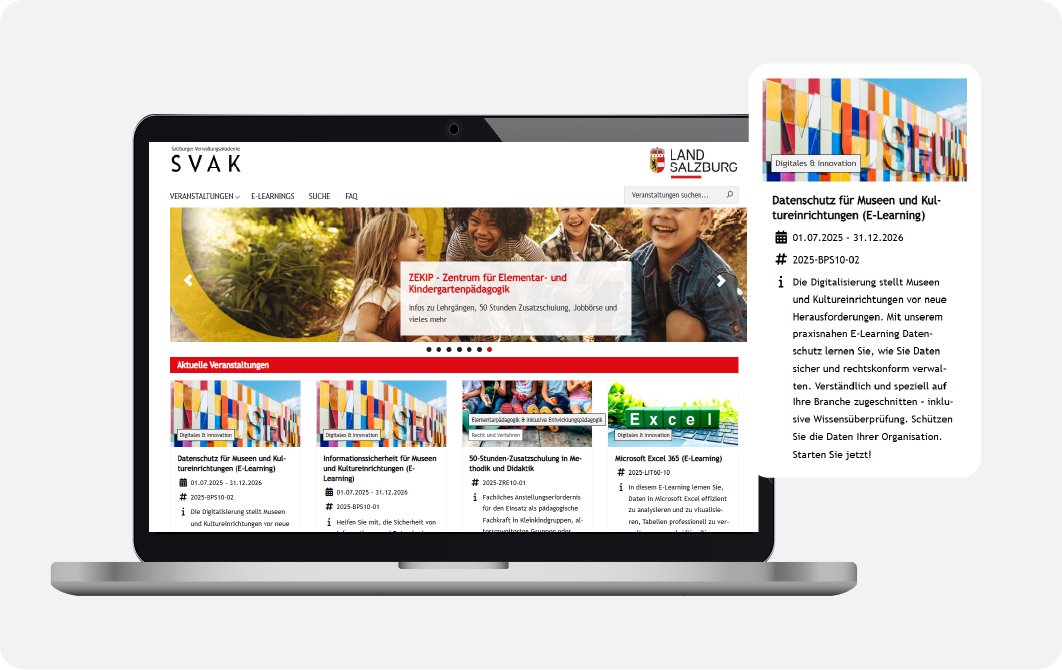
Results: Successful Implementation and Sustainable Establishment of LEMS Through Close Collaboration Between Land Salzburg and Think Modular.
In close collaboration between the State of Salzburg and think modular, LEMS was successfully implemented and sustainably established.
Think modular handled the entire project—from process analysis and technical implementation to system integration, hosting, design, user experience, and instructional design.
The system integrates key interfaces for authentication, HR systems, organizational data, and billing. Users benefit from self-service features such as independent registration and enrollment, as well as automated notifications.
Since March 2025, LEMS has been in operation and has quickly established itself as the central administrative tool of the Salzburg Administrative Academy. Within one year, approximately 750 events with around 24,000 participations were successfully managed via the platform.
Today, LEMS forms the digital backbone of learning and development management in the State of Salzburg, providing the foundation for a modern, scalable, independent, and sustainably evolving educational infrastructure.
A Scalable, Secure, and Integrated Technological Foundation as the Basis for Future-Proof Training Management
Significantly reduced administrative effort:
Automated workflows, approval processes, and enrollment mechanisms minimize manual tasks and make processes more efficient.
Seamless integration of existing systems:
Integration with HR systems, organizational data, and authentication creates a consistent data foundation without media disruptions.
High data security and compliance:
GDPR-compliant hosting and full control over data ensure security and trust.
Support for modern learning formats:
Integrated webinar and e-learning functionalities enable location-independent learning and new didactic approaches.
Data-Driven, Targeted, and User-Centric Training Management for Effective Learning and Development
Centralized management of all training activities:
An integrated platform replaces fragmented standalone solutions and provides full transparency across courses, participations, and resources.
Self-service for participants:
Features such as registration, course booking, and administration reduce organizational workload while improving the user experience.
Targeted communication with relevant audiences:
Dynamic user groups enable the precise and automated assignment of trainings and information.
Flexible and scalable system:
The modular architecture allows for easy adaptation to new requirements and future extensions.
Better decision-making through data analysis: A data warehouse provides the foundation for reporting and learning analytics, delivering valuable insights into usage, learning outcomes, and optimization potential.
Support for modern learning formats:
Integrated webinar and e-learning functionalities enable location-independent learning and new didactic approaches.
“Many thanks to the entire Think Modular team. We are delighted to work with LEMS and, together with our users, are excited about the opportunities it has opened up!”
Theresia Lackner
Director, Salzburg Administrative Academy
Interested?
Feel free to explore the platform yourself—many events are open to the public and not limited to employees of the State of Salzburg or municipalities.
We would be happy to support you in implementing your own learning and development platform—from the initial idea to ongoing operations.